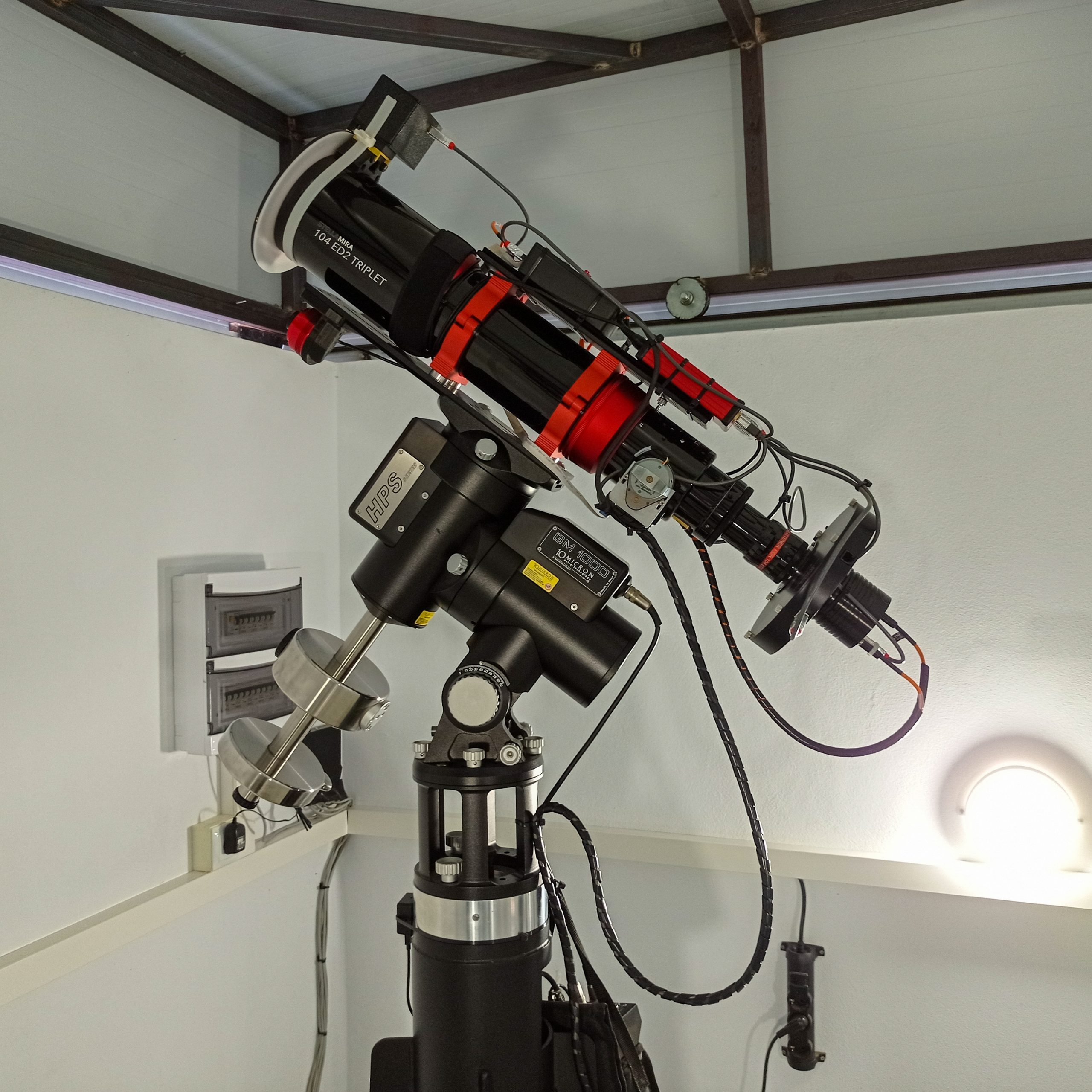
My good friend and brilliant photographer, Jamie Cooper, paid me a visit in the dreadful wet and windy weather yesterday to take some aerial shots of the house and observatory. The rain spotted the lens, the wind blew the camera about and the light was poor, but the results were still brilliant! Jamie’s website is here
Here is another image of Mars taken on Saturday night. Mars is receeding rapidly and will soon be under 10″ (10 arc-seconds) in diameter. Consider that the moon is about 30 arc-minutes across which is 1800 arc-seconds, meaning that the current disc of Mars would fit across the Moon 180 times!
All the more amazing that we amateurs can capture things like Volcanoes on Mars. Admittedly a big one! Olympus Mons (which was known as Nix Olympica) is the tallest known volcano in the Solar System. It stands about 21km high – that’s 3 times higher than Everest! In this image it stands out dark as it juts out from the cloud (just right of centre).
What a great event! I was very honoured to be invited to the party at the BBC Broadcasting House to celebrate 55 years of the Sky at Night. The remarkable Sir Patrick Moore has been presenting this excellent programme since it first aired on 24th April 1957 – an achievement unparalleled in broadcasting history, and the longest running TV programme ever.
Patrick is the greatest communicator of astronomy in history – fact! Forget the web, twitter, facebook and the rest, (says he on his blog!), this man has inspired more people to become astronomers, or to simply love the subject more than any other influence.
The party itself was brilliant. It was great chatting to the likes of Sir Tim Rice, Brian May, Jon Culshaw, Sir Terry Pratchett along with plenty of dedicated astronomers, both professional and amateur. I have shamelesly included some celeb pictures below! Thanks also to Pete Lawrence, Damian Peach and Ninian Boyle for your excellent company and banter during the trip up from Selsey.
A glorious sight in my 75mm APO refractor telescope last night. The night of April 3rd was cloudy when Venus was nicely in the main cluster, but I was still able to get both Venus and the Pleiades in the same field of view last night.
Venus is massively over-exposed here, but I like the effect of the burn-out and spikes it causes. You can just see the faint nebulosity around the main stars in the Pleiades. This image is the result of stacking 20 exposures each of 20 seconds using my ATIK 383L CCD camera and a white luminance filter – through the Pentax 75 APO.
This is vaguely astronomical I suppose, but I’m feeling pretty smug because today we commisioned our new Solar water heating system. We had Solar PV installed back in October and last week we went over the 1 MWh barrier and that’s during the Winter months! That means we could have powered an old-fashioned 1kW bar fire for 1000 hours, or lit a 15W energy-efficient light bulb for over 7.6 years. In any language, we could have powered the average American family for about 100 days!
So, today, the Solar water system went live. It’s already heated a full tank of hot water to 50 degrees C in just the afternoon so we won’t need to turn on the gas-fired boiler at all tonight.
Last week we had the loft re-insulated to over a foot thick, and the pipes re-lagged for free! (Thanks Tesco). Last year the 20+ year-old windows were replaced with very efficient new UPVC double-glazed units, and the walls are cavity insulated. We work mainly from home, so the cars remains on the drive for much of the time. Two Labradors and Chickens eat nearly all our food waste, and what they don’t eat gets composted.
Yep – feeling pretty smug right now! Pictures below.
Last night’s Mars image, shown here, illustrates the effect of ‘seeing’ conditions. The seeing was fairly good and stable last night – compare this image to the post, here, from the previous night when the seeing conditions were not so good.
Another Mars image taken last night from here in Ham.
The biggest and most obvious dark region called Syrtis Major is visible on the left in this image. It’s interesting that the Martian ‘day’ is about 24 hours and 40 minutes (in other words the time Mars takes to rotate once on its axis). This means that, for Earth-bound observers, we only see about 40 minutes of ‘new’ territory each night if we observe at the same time. So, Syrtis Major will slowly crawl into full view over the next few days (for UK observers at least).
A nice view also of the snake-like feature called Sinus Sabaeus with the ‘head’ part called Sinus Meridiani.
The seeing conditions were pretty jittery last night, so again this image is quite soft on detail. Not so many clouds visible either.
Took this image whilst parked on Brassknocker Hill just south of Bath. Just a bit earlier I had taken a series of killer images of the trio with Bath Abbey in the foreground with my son, Tom, only to discover that I had no memory card in the camera!
This image was about a 10 second exposure, the moon is deliberately over exposed in an attempt to pick up the stars in Orion and Taurus.
As described in my post on 22nd March this event was indeed a lovely sight yesterday evening with the young crescent moon very close to Jupiter and not far below Venus. Take advantage of this current clear weather in the UK and watch out this evening when the Moon will be much closer to Venus
This image was taken from my garden in Ham with a Canon 350D using the standard 18-55mm lens. Setting were ISO800, f/5, 1/8th second exposure.
High pressure is dominating over the UK for a few days bringing glorious weather and last night at least, great seeing conditions. I had perhaps the best eyepiece view of the Red Planet I can remember, and it was rock steady on the laptop screen. If only it was bigger than 13.2 arc-seconds!
The Northern Polar region is at the bottom and the dark area center bottom is Mare Acidelium with Sinus Meridian the dark region disappearing on the left. The large dark region in the upper part of the image is Mare Erythraeum. I think that the black dot on the right limb is the top of the volcano Olympus Mons poking through the clouds. (correction it is Ascraeus Mons poking up – thanks to Martin Mobberley for this). Click on the image to see it at full size.
I’m adding his image for comparison – taken 24 hours later. The seeing was not as good, so a ‘softer’ result was obtained.


Recent Comments